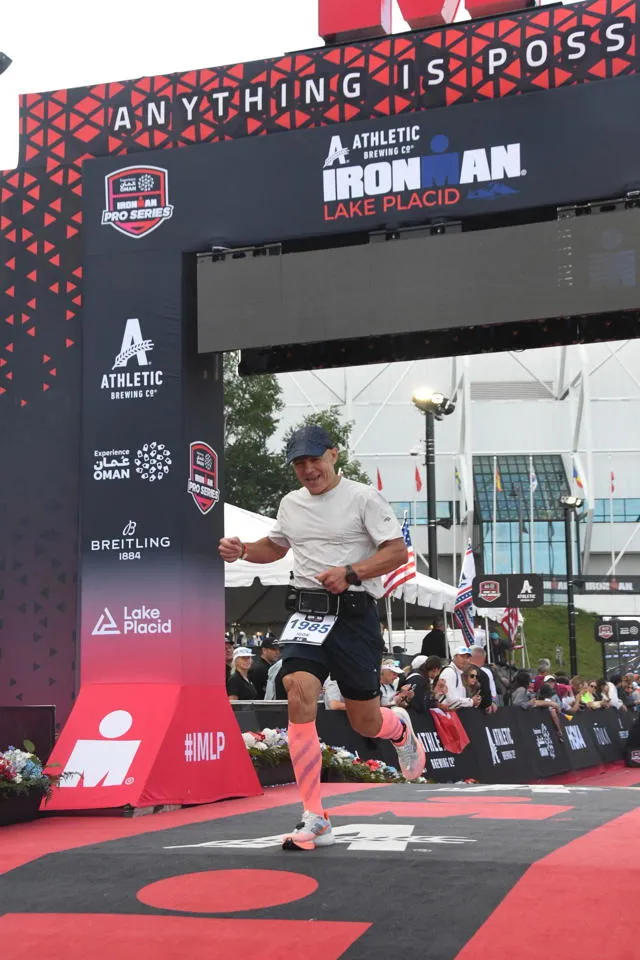
Ironman Lake Placid, July 19, 2026 — 35 min PR, HR 200
Prefer to watch this one? Here's the race recap on YouTube: Ironman Lake Placid 2026
Strategy
This was my 3rd full Ironman. My first, Alaska in 2022, doesn't fully count in my own head, the swim was shortened to 1.2 miles because of 58.5-degree water, so I never went the full distance. Lake Placid 2024 was really my first true one, and I finished in 12:47:03. Last year I couldn't even race, I crashed on energy leading into it and spent the off-season figuring out why. Going into this one, the goal was ambitious: shave close to 2 hours off my 2024 time and break 11 hours. My coach and I also changed the approach entirely. In 2024 I pushed all-out on the bike and paid for it on the run. This time the plan was to stay consistent on the bike and protect the run, since the run has quietly become my strongest discipline. One thing I got wrong before the race even started: I drove up Friday instead of Thursday, and I didn't account for how much a 4-hour drive plus a night in an unfamiliar bed would cost me. My body battery was at 95% Saturday morning, then down to 75% by race morning after a shorter night of sleep. Not the ideal starting position.
Race Experience
The swim start was my first real mistake. I lined up in the 1:10–1:20 pace corral even though I was targeting 1:20–1:25, just because I didn't want to wait around. What I hadn't accounted for was a wave of faster swimmers coming over the top of me from behind, I felt like a tiny fish swimming with sharks. I adjusted on the fly, most people were hugging the outside of the perimeter line, so I moved to the inside of it and found clear water. I kept repeating one thing to myself the whole way: don't chase people, focus on your breathing, stay consistent, stay calm. It worked. I came out of the water in 1:22:27, about 2.5 minutes faster than 2024, and I felt strong doing it.
Transition one was a new strategy for me. In past races I'd go straight from the swim to the bike in the same suit. This time I fully changed into a dry bike kit, and I decided against an extra layer since the water was 73 degrees and the air was sitting around 65. I also had my shoes already clipped into the bike, so I could run it out of transition instead of fumbling with them, and once I got to the mount line I made a point of running past the cluster of riders trying to get on their bikes at once, so nobody would run into me. All of that added up to a transition only about 30 seconds slower than 2024, even with a full outfit change.
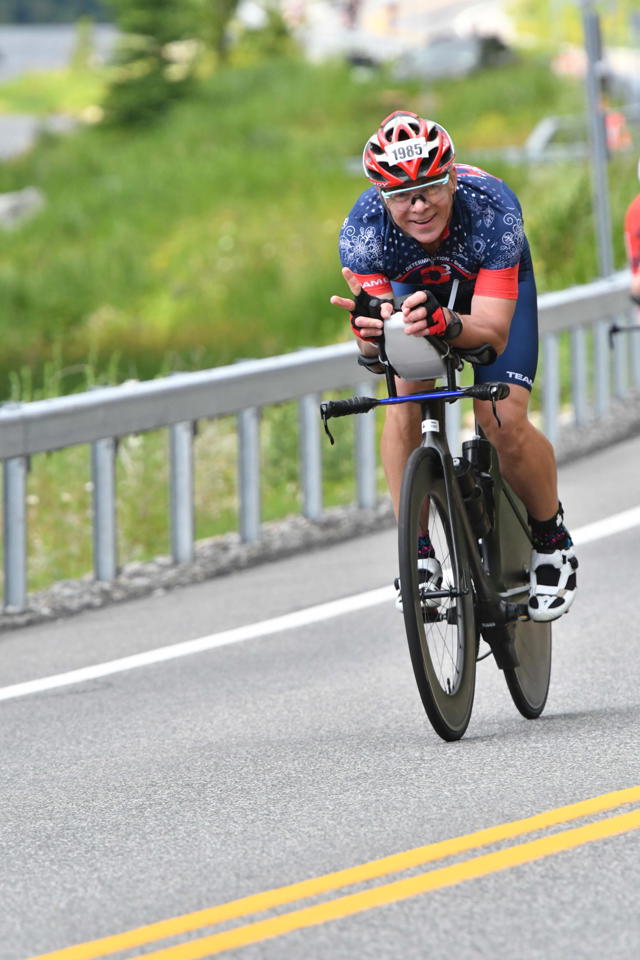
Nutrition on the bike was its own small battle. I was running INFINIT, one bottle an hour, with plain water and a Clif Bar in reserve. About 1.5 hours in I started craving sugar, ate half the Clif Bar too fast, and it sat wrong in my stomach for a while. On the second loop when the craving came back, I made myself chew it down slowly instead of swallowing it whole, and that fixed the problem completely. I also had a saddle adjustment issue I didn't catch until it was too late to fix mid-race, one side had drifted to a different setting than the other, and by the second loop I could feel it in my left side. Small thing, but it taught me exactly where that saddle needs to sit for next time.
Then the weather turned on me. Partway through the second loop the clouds cleared out and a headwind picked up, the kind that people were complaining about after the race. Instead of fighting it upright, I leaned into the bars and stayed as compact as I could, even on the downhills, and just kept moving. My average heart rate on the bike stayed around 127, well under my threshold of 164, so even with the wind working against me, the effort itself felt controlled.
Transition two, another full change, bike kit off, running shorts and shirt on. I knew it would cost a few seconds, but I'd rather lose that time and feel comfortable for the run than race the whole marathon in a bike kit. And somehow it still ended up close to a minute and a half faster than my 2024 transition, which told me I'd been struggling more than I realized last time.
The moment that actually changed how I think about racing happened on the run. About 4 minutes in, my power meter stopped syncing, no more effort data, just pace and heart rate left on my watch. Then I looked down and saw 180 beats per minute. My threshold is 164. I've never seen a number like that on myself, not even in a final sprint. My first instinct was to slow down and bring it back to 150, but the second I picked the pace back up, it climbed right back to 180. At that point I made a call: either the monitor was malfunctioning, or my body was handling more than I thought it could, and either way, chasing the number wasn't going to help me. So I ran by feel instead. My first-loop average ended up at 170 with a peak of 200, nearly 20% above the highest heart rate I'd ever recorded in a race.
I'd planned a negative split, easing off the opening downhill, holding a steady pace through the middle miles, then emptying whatever was left in the final stretch. The heart rate spike changed that math some, I walked a couple of hills on the second loop just to bring the number back down, and my pace faded some as a result. But the last mile was the fastest of the day. And here's the part that surprised me most: for the first time in any race I've done, even smaller ones, I never once asked myself why I was doing this. Every prior race has had a low point where that question crept in. This one didn't. Even fighting the headwind, even walking those hills, I was just enjoying being out there, and I finished with a smile.
Outcome
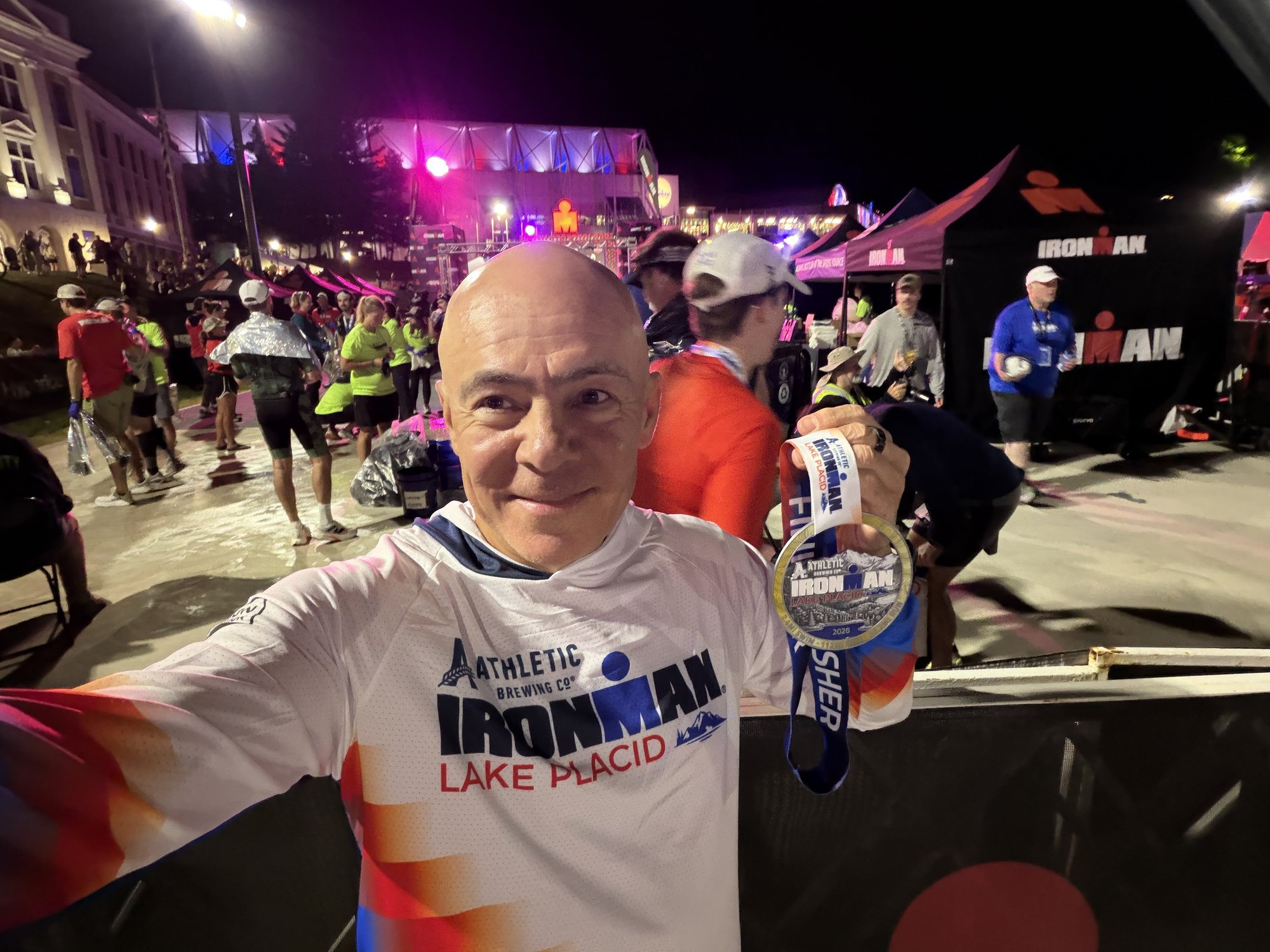
I missed my sub-11-hour target, but I improved on my 2024 time by 35 minutes, finishing in 12:12:47. I'm already committed to going back to Lake Placid in 2027 to get that 11-hour number.
Lessons Learned
Arriving Friday instead of Thursday cost me real recovery before I ever got to the start line, a 4-hour drive plus a night in an unfamiliar bed is not nothing. Next time I'm getting there by Thursday at the latest.
My run improved disproportionately to my bike this year, and the reason is simple: travel commitments cost me several long bike training weekends leading into this race. The discipline you're most consistent with in training is the one that shows up on race day, no shortcuts around that.
For the first time ever, I didn't spend any part of this race questioning why I do this at my age. What I've learned is that energy decline with age is largely a myth, it comes down to understanding how to produce, retain, and restore your own energy. Once you master that cycle, it applies to far more than racing.
Custom HTML/CSS/JavaScript
Get My Hard-Won Lessons Straight To Your Inbox